
Requiem for a Dream
Darren Aronofsky’s second feature follows four Coney Island lives through a single brutal seasonal arc. Twenty-five years on, it remains one of the few American films of its era that refused the consolation of an ending.
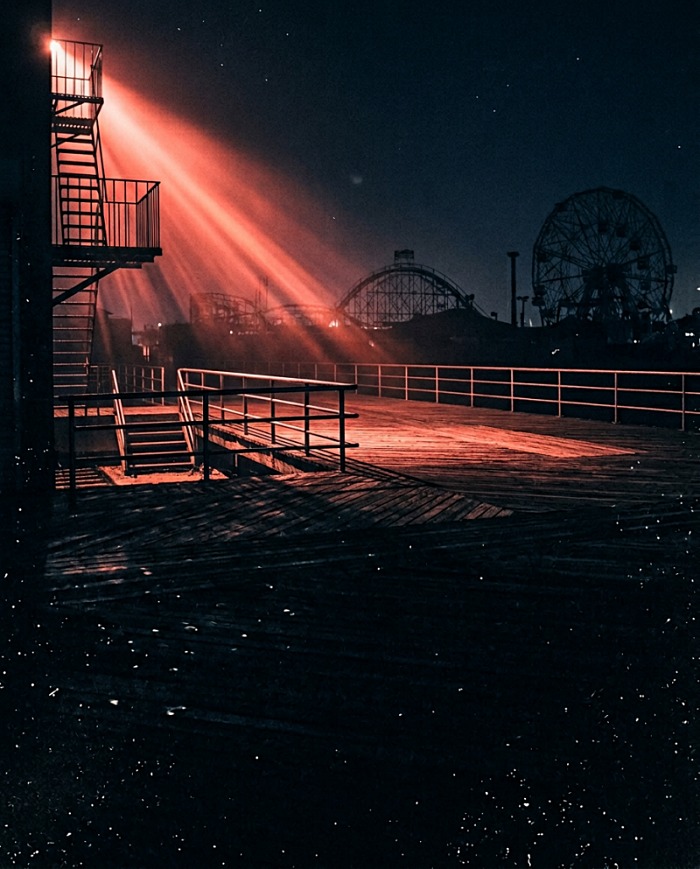 Reel A · Frame 001
Dir. Aronofsky
DP. Libatique
Score. Mansell
01
Reel A · Frame 001
Dir. Aronofsky
DP. Libatique
Score. Mansell
01
What it is, and what it does.
Adapted from Hubert Selby Jr.’s 1978 novel, Aronofsky’s film follows four people through a single Coney Island summer, autumn, and winter — a widowed mother, her son, her son’s girlfriend, and his closest friend. What begins as a film about dreams becomes, scene by carefully sequenced scene, a film about what happens when dreams become the only thing worth living for.
The film’s architecture is its argument. Four trajectories move forward in parallel, rhythms ticking in sync, each character reaching for a version of happiness that the camera patiently redefines as destruction. The pupils dilate. The refrigerator talks. The television audition never ends. A specific editorial grammar — more than two thousand cuts in a 102-minute film, against the typical six to seven hundred — turns the act of consumption into something that can be measured in frames.
It is not a film about drugs in the way other films are about drugs. It is a film about hunger, and about what happens to a body that cannot stop reaching for the thing that hollows it. The camera strapped to the chest — the Snorricam shot Aronofsky would later make famous — turns walking into vertigo. The split-screen collapses two lives into a single breathing surface. The score tightens like a belt.
Twenty-five years on, it remains one of the very few American films of its era that refused the consolation of an arc. It does not redeem. It does not resolve. It observes, and it asks you to observe with it.
“Every character in the film wants the same thing. Every character gets exactly that. That is what makes it a horror film.”
— On the Film’s Cruel SymmetryFour lives, one summer.
The film braids four stories — each reaching for a different dream, each finding the same shape at the bottom of it.
Sara Goldfarb
Ellen BurstynA widowed mother whose dream is a television appearance. Her performance anchors the film; her Oscar nomination is still among the most cited of its decade.
Harry Goldfarb
Jared LetoSara’s son. Plans a future with Marion, a small business, a way out. The plan does not survive contact with the plan.
Marion Silver
Jennifer ConnellyAn artist, a girlfriend, a daughter. Her thread is the one the film handles most carefully and punishes most completely.
Tyrone C. Love
Marlon WayansHarry’s closest friend. His relationship with his mother provides the film’s most openly tender moments — and the cruellest contrast.
A small piece of music that would not stay small.
Clint Mansell composed the film’s score, performed by the Kronos Quartet. The central motif — titled Lux Aeterna — has since become one of the most widely licensed and imitated pieces of orchestral music in post-2000 trailer history.
It has scored trailers for films it has no business being in. It has been re-orchestrated as Requiem for a Tower for The Lord of the Rings: The Two Towers. It has been remixed, re-scored, covered, and parodied. A simple rising six-note figure, written for a chamber quartet, has become the sound that commercial cinema reaches for when it wants to signal gravity.
The reason it is everywhere is also the reason the film’s final sequence is so devastating: it does not feel like music. It feels like the machinery of consequence, building.
From the journal
Writing about the film, and about the wider cinema it sits inside.
- 8 Best Columbia Jackets (September 2026) Tested & Reviewed
 When outdoor friends ask me what jacket to buy without dropping a week’s paycheck, I point them straight to Columbia. After testing dozens of pieces over years of … Read more
 - 10 Best Helicopter Model Kits (September 2026) Expert Reviews
 Building scale rotor aircraft is one of the most rewarding corners of the scale modeling hobby, and after spending the last few months assembling ten of the most … Read more
 - 8 Best Desktop Computers for Seniors (September 2026) Unbiased reviews
 Picking the best desktop computer for seniors shouldn’t feel like solving a puzzle. I spent six weeks testing eight all-in-one desktops with my parents and three of their … Read more
 - 8 Best Slot Cars Paint Booths (September 2026) Unbiased reviews
 Painting slot cars without a proper booth is asking for overspray on your workbench, your walls, and probably your spouse. I learned this the hard way after my … Read more
 - 10 Best Deep Seat Sofas (September 2026) Unbiased reviews
 If you have ever sunk into a sofa at a friend’s house and refused to get up, you already understand the appeal of the best deep seat sofas. … Read more
 - Best Premium Ductless Mini Split AC Systems (September 2026) Unbiased reviews
 When we started testing mini splits three years ago for our home renovation clients, we quickly learned that not all ductless systems deliver on their premium promises. After … Read more
 - 10 Best Portable Misting Fans for Sports Events (September 2026) Unbiased reviews
 If you’ve ever coached a summer softball game in 95-degree heat, you know exactly how brutal it feels to stand in a dugout with no airflow. Sweaty helmets, … Read more
 - 12 Best Commercial Wood Chipper Shredders for Tree Service (September 2026) Unbiased reviews
 I spent the last three months putting 12 commercial wood chipper shredders through real tree service work. I cleaned up oak storm damage, processed brush piles for a … Read more
 - 10 Best Bikes for Heavy People (September 2026) Unbiased reviews
 Finding the best bikes for heavy people used to feel like searching for a needle in a haystack. I spent three months testing 10 different models, riding them … Read more
 - 8 Best Young Miniatures Bust Kits (September 2026) Expert Reviews
 Building a strong shelf of historical busts starts with choosing the right resin kit, and Young Miniatures bust kits have earned a reputation among figure painters for crisp … Read more
 - 8 Best Rust Converters for Classic Cars (September 2026) Reviews
 I have spent the last 20 years wrenching on classic Mustangs, C10 Chevys, and a long-suffering 1969 Beetle that refuses to stay rust-free. During that time, I have … Read more
 - 8 Best Drywall Tool Kits (September 2026) Unbiased reviews
 I have hung, taped, and sanded enough drywall over the years to know that the right tool kit can turn a back-breaking weekend into a satisfying one. After … Read more
 - 9 Best Winter Tires for Subaru Outback (September 2026) Reviews
 If you live anywhere that gets real winter weather, the best winter tires for Subaru Outback aren’t a luxury; they’re a safety upgrade. The Outback’s Symmetrical AWD system … Read more
 - 8 Best Cordless Routers (September 2026) Unbiased reviews
 I spent the last 60 days routing everything from picture frames to cabinet doors with eight cordless routers, and I have some opinions. If you are hunting for … Read more
 - 8 Best 8×42 Binoculars (September 2026) Unbiased reviews
 I still remember the morning I missed a rare Blackburnian warbler because my old binoculars were too dim and shaky. That was the day I committed to finding … Read more
What it was, by the numbers.
Academy Award Nomination
Burstyn, Best Actress
Cuts in the Film
Against a typical 600–700
Minutes of Runtime
Four seasonal chapters
Years in the Canon
Still assigned, still studied
The novel came first.

The film’s source is Hubert Selby Jr.’s 1978 novel of the same title — the author’s third published work, following Last Exit to Brooklyn (1964) and The Room (1971). Selby wrote in long, run-on prose that fused interior monologue, street vernacular, and a rhythm adjacent to prayer — sentences that felt overheard rather than composed.
He collaborated on the film’s screenplay with Aronofsky, and has a brief on-screen cameo. He died in 2004.
His work remains difficult, uncompromising, and central to any serious account of twentieth-century American fiction about the body, the city, and the edges of the permissible.
 III
Reel C · Present Day
III
Reel C · Present Day
A website that decayed as you used it.
This domain — requiemforadream.com — was the official site for the film when it released in 2000, built by Hi-ReS!, a London digital agency. The brief was simple and uncomfortable: the site would decay as the visitor moved through it, shifting from white to grey to black before eventually ejecting the user entirely. A film about consumption, and a website that let itself be consumed.
It won two Webby Awards, a D&AD Pencil, and was later exhibited at the Barbican — part of the “Digital Archaeology” component of its 2014 “Digital Revolution” show. It is one of the few film marketing sites to be preserved as a work of design in its own right.
Flash is dead. The original site cannot run on a modern browser. But the name — we think — deserves to continue pointing at something with care in it. So it points here now. A journal of film, television, and cinema, run by people who remembered the original and are carrying it carefully.
About this journal
Edited and written by a small team who care more than is reasonable about the moving image. New dispatches weekly. The archive grows monthly. Everything else is in the writing.
Read our story